
Performance Marketing Strategy: How to Scale ROI Across Channels
Spending more on marketing does not guarantee growth.
Many businesses run Google Ads, Meta Ads, LinkedIn Ads, retargeting campaigns, email campaigns, and landing pages, but still struggle to prove which channels are actually generating qualified leads, customers, and revenue. The issue is not always the ad budget. The issue is often the system behind the budget.
A strong performance marketing strategy connects every campaign to measurable outcomes. It helps you understand what is working, what is wasting money, where leads are dropping off, and which channels deserve more investment.
Want your marketing spend to generate better leads and measurable ROI? Arevei helps businesses build conversion-focused website development, AI-powered marketing systems, CRO, UX improvement, landing page optimization, website speed optimization, and lead-generation strategy.
What Is a Performance Marketing Strategy?

A performance marketing strategy is a data-driven plan for running, measuring, optimizing, and scaling marketing campaigns based on measurable business outcomes — clicks, leads, qualified leads, form submissions, consultation bookings, sales calls, purchases, revenue, and marketing ROI.
| Channel | Best Use | Common Goal |
|---|---|---|
| Google Ads | High-intent demand capture | Leads, purchases, calls |
| Meta Ads | Awareness, retargeting, lead generation | Leads and engagement |
| LinkedIn Ads | B2B targeting | Qualified leads and demos |
| YouTube Ads | Awareness and education | Retargeting and consideration |
| Email marketing | Lead nurturing and retention | Clicks, calls, repeat sales |
| Retargeting | Bringing back visitors | Lower drop-offs |
| Landing pages | Conversion point | Leads and customers |
Performance Marketing vs General Digital Marketing
| Digital Marketing | Performance Marketing |
|---|---|
| Covers broad online presence | Focuses on measurable results |
| Measures reach and engagement | Measures CPL, CAC, ROAS, ROI |
| Can be long-term and broad | Usually tied to specific campaigns |
| Success can be harder to attribute | Success tracked through actions and outcomes |
Step-by-Step Performance Marketing Strategy Framework
Step 1: Define the Business Outcome
Start with the business result you want. A clear goal guides budget, channel selection, creative, landing page design, and tracking.
Weak goal: "Run ads and get leads."
Strong goal: "Generate 80 qualified leads per month at a cost per qualified lead below ₹2,500 and convert at least 20% into consultation bookings."
Step 2: Define the Target Audience and Offer
| Funnel Stage | Offer |
|---|---|
| Cold audience | Free checklist or guide |
| Warm audience | Case study or audit |
| High-intent audience | Free consultation |
| Existing lead | Strategy call reminder |
| Past customer | Upgrade or referral offer |
Step 3: Select Channels Based on Intent
| Channel | Intent Level | Best Use |
|---|---|---|
| Google Search Ads | High | Capture active demand |
| Meta Ads | Low to medium | Awareness, retargeting, lead magnets |
| LinkedIn Ads | Medium to high | B2B targeting and authority |
| Warm | Nurturing and conversion | |
| Retargeting | Warm to hot | Bring back non-converters |
Step 4: Build Campaign-Specific Landing Pages
A paid ads optimization strategy should not send all traffic to the homepage. Campaign-specific landing pages perform better because they match the ad message and user intent more closely.
Example: Ad promise: "Get more leads from your website." Landing page headline: "Turn More Website Traffic Into Qualified Leads." CTA: "Get a Free Website Conversion Review." This creates message match across the campaign.
Step 5: Set Up Tracking Before Scaling
Never scale campaigns before tracking is clean. Track ad platform conversions, GA4 events, form submissions, button clicks, call bookings, UTM parameters, CRM lead source, lead quality fields, sales stage movement, and revenue outcome.
Step 6: Launch, Measure, and Segment Data
Once campaigns are live, review performance by channel, campaign, ad group, keyword, creative, audience, device, location, landing page, lead quality, and funnel stage. One campaign may have a low CPL but weak lead quality — another with higher CPL may be more profitable.
Step 7: Optimize Budget Based on ROI
| Campaign Performance | Action |
|---|---|
| Low CPL, low quality | Improve targeting or qualification |
| High CPL, high quality | Review CAC and scale carefully |
| High CTR, low conversions | Fix landing page or offer |
| High spend, low ROI | Pause or rebuild |
| High ROI, stable volume | Scale gradually |
Step 8: Use Automation to Improve Follow-Up
Performance marketing does not end when a lead submits a form. Lead submits form → enters CRM → source saved → welcome email sent → lead score assigned → sales receives task if high intent → lead gets nurture emails → non-booked leads enter retargeting. This reduces lead leakage and improves conversion from paid campaigns.
Step 9: Scale Winning Campaigns Strategically
Scaling is not just increasing budget — it requires control. Increase budget gradually, expand high-performing audiences, duplicate winning creative angles, test new landing page variations, expand keywords, build lookalike audiences, and add email nurturing.
Step 10: Build a Continuous Optimization System
Weekly review: campaign spend, CPL, CTR, landing page conversion rate, lead quality, sales feedback. Monthly review: cost per qualified lead, CAC, ROAS, channel ROI, revenue by campaign. Quarterly review: channel mix, creative strategy, offer performance, market positioning.
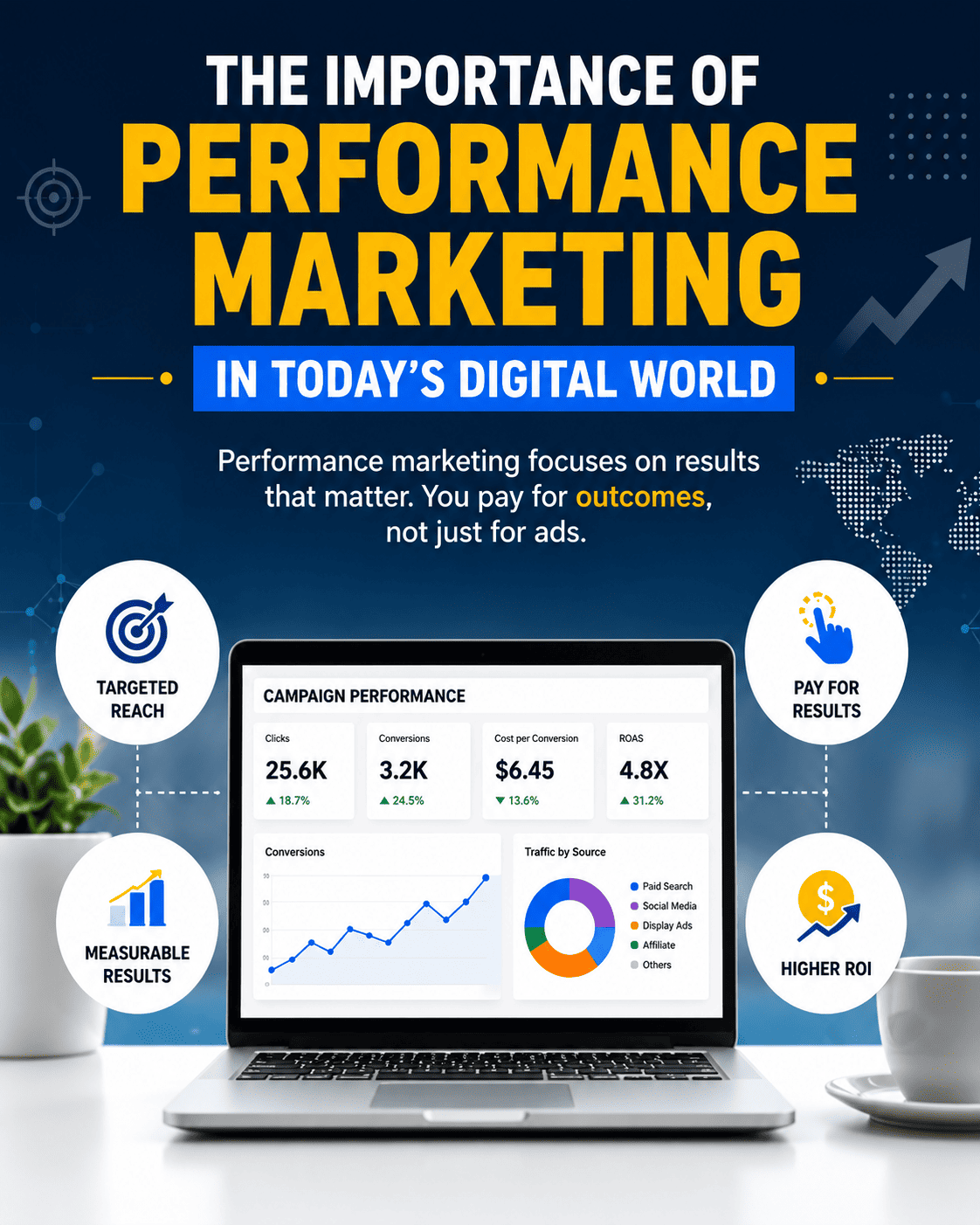
Why Personalization Matters for ROI
McKinsey reports that personalization can reduce customer acquisition costs by up to 50%, lift revenues by 5% to 15%, and increase marketing ROI by 10% to 30%. This is why performance marketing should not rely on generic campaigns. The strongest ROI often comes from matching message, offer, landing page, and follow-up to user intent.
Common Performance Marketing Mistakes
Mistake 1: Optimizing for Cheap Leads Only
Fix: Track cost per qualified lead, sales-qualified leads, and customer acquisition cost.
Mistake 2: Sending Paid Traffic to the Homepage
Fix: Create campaign-specific landing pages with clear message match.
Mistake 3: Scaling Too Early
Fix: Validate targeting, creative, landing page conversion, lead quality, and sales conversion before scaling.
Mistake 4: Ignoring Landing Page Speed
Fix: Use PageSpeed Insights, compress images, reduce scripts, and improve mobile experience.
Mistake 5: Measuring Form Submissions Only
Fix: Track qualified leads, booked calls, proposals, customers, and revenue.
How to Measure Performance Marketing Success
Measure the full journey from ad spend to revenue — ad metrics (CTR, CPC, CPM), landing page metrics (conversion rate, bounce rate), lead quality metrics (CPL, cost per qualified lead, MQL/SQL rates), sales metrics (call show-up rate, close rate), and revenue metrics (ROAS, CAC, marketing ROI).
FAQs
1. What is a performance marketing strategy?
A performance marketing strategy is a data-driven plan for running and optimizing campaigns based on measurable outcomes such as leads, conversions, revenue, ROAS, CAC, and marketing ROI.
2. Why are landing pages important for performance marketing?
Paid traffic only creates ROI when visitors convert. A clear, fast, campaign-specific landing page can improve conversion rates and reduce cost per lead.
3. What metrics should performance marketing campaigns track?
CTR, CPC, CPL, cost per qualified lead, conversion rate, ROAS, CAC, lead-to-customer conversion, revenue by channel, and marketing ROI.
4. Is performance marketing useful for service-based businesses?
Yes. It helps generate qualified leads, track campaign ROI, improve consultation bookings, reduce wasted spend, and connect marketing activity to sales outcomes.
If your ads are getting clicks but not enough qualified leads, Arevei can help you improve the full funnel from traffic to conversion to revenue.
Build Your Performance Marketing Strategy With Arevei