
Advanced CRO Strategies: How to Scale Conversions Beyond Basic Optimization
Getting traffic is not enough.
Many businesses already have website visitors, ad clicks, landing pages, email campaigns, and lead forms. But after basic improvements, conversion growth often slows down. Changing button colors, rewriting one headline, or moving a form slightly higher may help at the beginning, but it rarely creates long-term growth.
This is where advanced CRO strategies become important.
Advanced CRO strategies help businesses optimize the complete conversion journey, not just one page. They use funnel data, behavioral segmentation, personalization, UX analysis, page speed, testing frameworks, automation, and customer psychology to improve how users move from visitor to lead, from lead to qualified prospect, and from prospect to customer.
Want to turn more of your existing traffic into qualified leads? Arevei helps businesses build conversion-focused website development, AI-powered marketing systems, CRO, UX improvement, landing page optimization, website speed optimization, and lead-generation strategy.
What Are Advanced CRO Strategies?
Advanced CRO strategies are data-backed conversion optimization methods used after basic website improvements have already been made.
Basic CRO usually focuses on simple improvements such as changing CTA text, rewriting a headline, moving a form, adding testimonials, testing a button color, or reducing form fields.
Advanced CRO goes deeper — full-funnel optimization, behavioral segmentation, personalized user journeys, multi-step conversion flows, micro-conversion tracking, advanced A/B testing, landing page speed, CRM and automation integration, lead quality measurement, and revenue impact analysis.
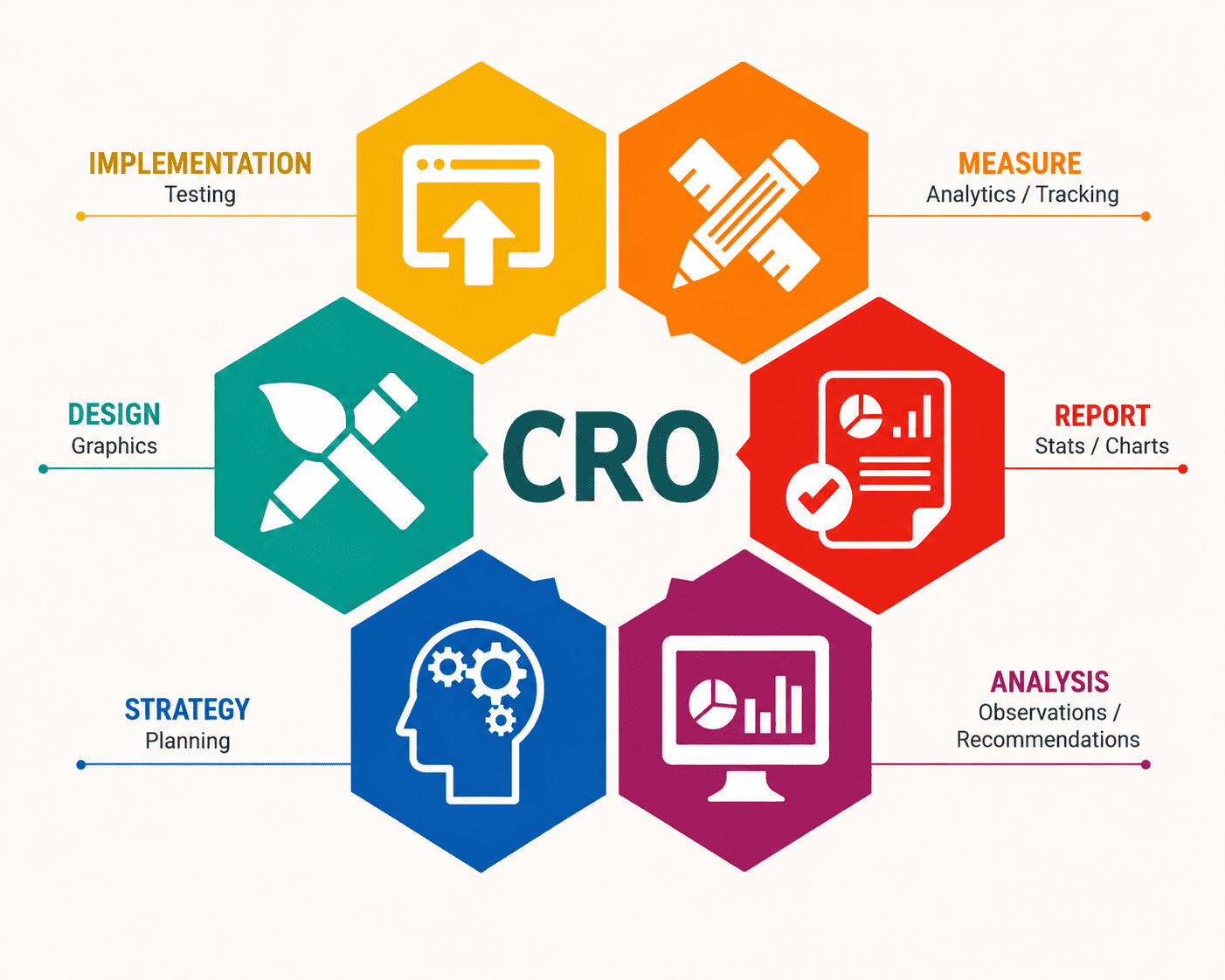
Why Advanced CRO Strategies atter After Basic Optimization
| Area | Basic CRO | Advanced CRO |
|---|---|---|
| Focus | Single page | Full funnel |
| Data used | Clicks and page conversions | Funnel behavior, lead quality, revenue |
| Testing | Simple A/B tests | Hypothesis-led testing and segmentation |
| Personalization | Limited | Behavior-based and intent-based |
| Goal | More form submissions | Better leads, customers, and ROI |
| Optimization level | Visual and copy changes | UX, speed, automation, funnel flow, analytics |
Google's Think with Google research found that as mobile page load time goes from 1 second to 10 seconds, the probability of a mobile visitor bouncing increases by 123%. As page elements increase from 400 to 6,000, the probability of conversion drops by 95%. This is why website speed optimization for conversions should be part of a serious CRO strategy.
Step-by-Step Advanced CRO Strategy Framework
Step 1: Move From Page-Level CRO to Funnel-Level CRO
Basic CRO asks: "How can we improve this page?" Advanced CRO asks: "Where is the user dropping off across the full journey?"
| Funnel Stage | Optimization Question |
|---|---|
| Traffic | Are we attracting the right audience? |
| Landing page | Is the message clear and relevant? |
| Form | Is the next step easy and valuable? |
| Email nurturing | Are leads receiving the right follow-up? |
| Retargeting | Are non-converters being brought back? |
| Sales handoff | Are high-intent leads sent to sales quickly? |
| Conversion | Are buyers confident enough to act? |
Step 2: Segment Users by Intent and Behavior
Not every visitor should receive the same message. A cold visitor from a social ad has different intent than a warm visitor returning from an email campaign.
| Segment | Signal | Best Experience |
|---|---|---|
| Cold visitor | First visit from ad or social | Education and problem framing |
| Warm visitor | Repeat visits or email clicks | Case studies and proof |
| High-intent visitor | Pricing or service page visits | Direct CTA and consultation offer |
| Returning lead | Already in CRM | Personalized follow-up |
| Inactive lead | No engagement for 60–90 days | Re-engagement offer |
McKinsey reports that personalization can reduce customer acquisition costs by up to 50%, lift revenues by 5% to 15%, and increase marketing ROI by 10% to 30%. That is why personalization is not only a design tactic — it is a revenue strategy.
Step 3: Build Multi-Step Conversion Flows
Long forms create friction, but many businesses still need enough information to qualify leads. A multi-step form solves both problems by making the first action easier while collecting deeper information gradually.
| Form Type | Best For | CRO Advantage |
|---|---|---|
| Single-step form | Simple inquiries | Fast for low-friction actions |
| Multi-step form | Consultations and qualified leads | Improves commitment and qualification |
| Progressive form | Returning leads | Reduces repeated questions |
| Quiz-style flow | Recommendations or audits | Creates engagement |
Step 4: Optimize Micro-Conversions
Not every user will book a call on the first visit. Advanced CRO tracks smaller actions that indicate progress — CTA clicks, scroll depth, pricing page visits, case study views, form starts, guide downloads, email CTA clicks, and return visits.
| Micro-Conversion | What It Indicates | Next Action |
|---|---|---|
| Case study view | Proof-seeking behavior | Show consultation CTA |
| Pricing page visit | High intent | Trigger sales alert |
| Guide download | Early interest | Start nurture workflow |
| Form start but no submit | Conversion friction | Send reminder or improve form |
| Email CTA click | Growing interest | Send service-specific offer |
Step 5: Use Advanced A/B Testing Frameworks
Advanced testing is not about guessing. It is about testing hypotheses based on user behavior, funnel data, and business goals.
Weak approach: "Let's test a red button."
Strong hypothesis: "Users are not booking calls because the value of the strategy call is unclear. If we rewrite the CTA and add a short 'what happens next' section near the form, form completion rate should improve."
Testing Priority Formula: Priority = Impact × Confidence × Ease. Prioritize tests with high impact, strong evidence, and reasonable effort.
Step 6: Personalize the Journey by Traffic Source
| Traffic Source | Likely Intent | Better CRO Approach |
|---|---|---|
| Google Search | High intent | Strong offer and direct CTA |
| Professional research | Proof, authority, case studies | |
| Instagram or Facebook | Lower to medium intent | Education and lead magnet |
| Warm intent | Personalized CTA | |
| Retargeting | Familiar with brand | Trust and conversion CTA |
Step 7: Use Psychological Triggers Ethically
| Trigger | How to Use It Ethically |
|---|---|
| Social proof | Show real testimonials, results, or case studies |
| Authority | Share expertise, frameworks, and credible insights |
| Urgency | Use only real deadlines or limited capacity |
| Risk reduction | Explain guarantees, process, or next steps |
| Clarity | Make the offer easy to understand |
| Commitment | Use small steps before bigger actions |
Step 8: Connect CRO With Automation and Lead Scoring
Advanced CRO should not stop after a form submission. Post-conversion CRO questions:
- Does the lead get an instant confirmation email?
- Is the lead sent to the CRM and scored?
- Does sales receive a high-intent alert?
- Does the user get a relevant nurture sequence?
- Are retargeting audiences updated?
- Is revenue connected back to the original campaign?
Step 9: Improve Website Speed and Core Web Vitals
Advanced CRO should include technical performance. Web.dev explains that Core Web Vitals are measurable user experience signals that reflect loading performance, interactivity, and visual stability. Rakuten 24 increased revenue per visitor by 53.37% and conversion rate by 33.13% after improving Core Web Vitals.
CRO Speed Checklist
- Compress large images and use modern formats
- Remove unused scripts and reduce third-party tags
- Improve server response time
- Avoid layout shifts
- Optimize mobile loading
- Test using PageSpeed Insights
- Monitor Core Web Vitals over time
Step 10: Build a Continuous CRO System
| Stage | Action |
|---|---|
| Data collection | Gather analytics, CRM, heatmap, and sales data |
| Insight generation | Identify patterns and drop-offs |
| Hypothesis creation | Explain why users are not converting |
| Test planning | Prioritize high-impact tests |
| Implementation | Launch controlled changes |
| Measurement | Track conversion and lead quality |
| Scaling | Apply winning insights to other pages or funnels |
Common Advanced CRO Mistakes
Mistake 1: Testing Random Ideas
Fix: Base every test on a clear hypothesis supported by data.
Mistake 2: Optimizing Only for More Leads
Fix: Track lead quality, sales-qualified leads, customer acquisition cost, and revenue.
Mistake 3: Ignoring Mobile Performance
Fix: Review mobile speed, form usability, CTA visibility, and readability.
Mistake 4: Using the Same Page for Every Audience
Fix: Segment experiences by traffic source, behavior, funnel stage, and intent.
Mistake 5: Not Connecting CRO With Sales Data
Fix: Connect website data with CRM outcomes, qualified leads, booked calls, proposals, and revenue.
Mistake 6: Treating CRO as a One-Time Project
Fix: Build a continuous CRO system with regular testing and review.
How to Measure Advanced CRO Success
Measure across the full funnel — landing page conversion rate, CTA click-through rate, form completion rate, marketing qualified leads, sales qualified leads, lead-to-customer conversion, customer acquisition cost, revenue per lead, cost per qualified lead, and marketing ROI.
FAQs
1. What are advanced CRO strategies?
Advanced CRO strategies are deeper conversion optimization methods that improve the full funnel — behavioral segmentation, personalization, advanced testing, UX improvement, website speed optimization, automation, and revenue tracking.
2. How can advanced CRO strategies increase conversion rate beyond 5%?
By improving traffic relevance, landing page clarity, CTA strength, form usability, trust signals, personalization, speed, lead nurturing, and sales follow-up together as a system.
3. What is the difference between basic CRO and advanced CRO?
Basic CRO focuses on simple page changes such as headlines, buttons, and forms. Advanced CRO focuses on full-funnel optimization, user behavior, segmentation, automation, CRM data, testing systems, and revenue impact.
4. Why should CRO include website speed optimization?
Slow pages increase bounce risk and reduce user engagement. Faster pages improve user experience and can support better conversion performance, especially on mobile.
Ready to scale conversions beyond basic optimization? Arevei helps businesses build advanced CRO strategies that turn more website traffic into qualified leads and measurable business growth.
Get Advanced CRO Strategy From Arevei